
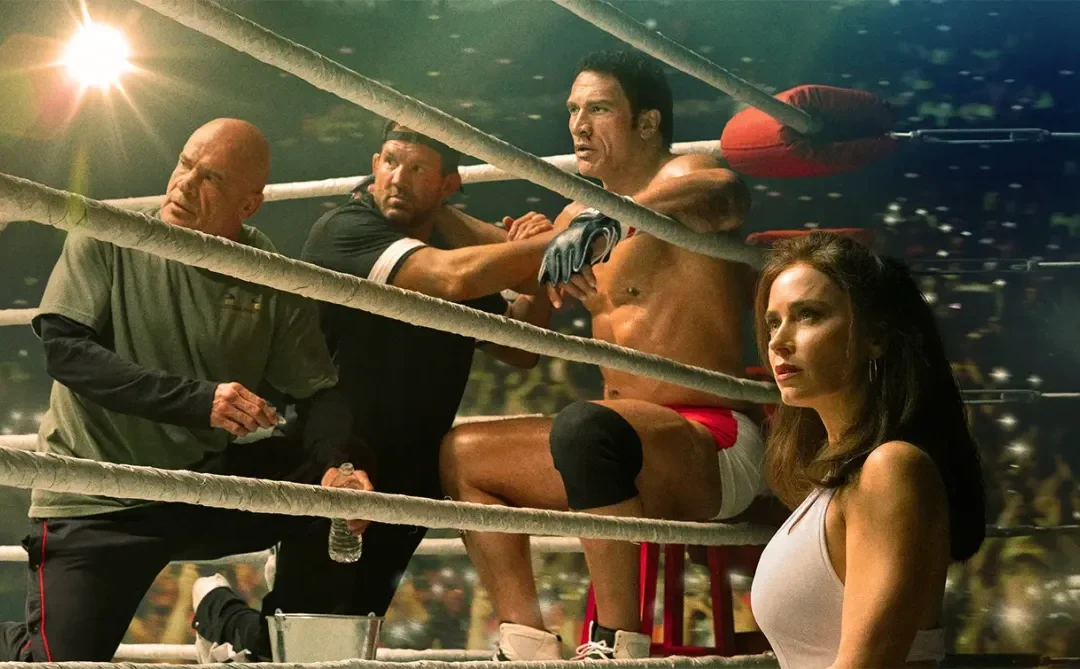
The Smashing Machine (3 stars out of 4)
Among Dwayne Johnson’s various eccentricities, one of the most peculiar to come to light in recent years is a contract clause that insists his film characters never “lose” a fight. I thought of that while watching Johnson’s performance in “The Smashing Machine,” a biopic about early UFC/MMA star Mark Kerr that suggests good things happen when actors like Johnson decide to step outside of their comfort zones.
The story is set in the late 1990s, as Mixed Martial Arts was still emerging as a sport. We meet Kerr during a montage of fight scenes from a tournament in Sao Paulo, Brazil in 1997 at the beginning of his career. Though the sport is still developing, Kerr’s early success quickly makes him one of its most prominent stars.
Because MMA is still on its rise, fighters like Kerr have to spend a lot of time in Japan, fighting in an equivalent fighting league called Pride. Much of director Benny Safdie’s “Smashing Machine” takes place in Japan, following Kerr along with his best friend (and fellow fighter) Mark Coleman (Ryan Bader), as well as his live-in girlfriend Dawn (Emily Blunt).
“Smashing Machine” draws your attention for a lot of reasons, but perhaps none as much as the odd dissonance in Johnson’s character. Kerr is an imposing figure—and not just because Johnson is playing him—but he speaks with a kind of slow and deliberate articulation. Whether speaking to the media, Dawn, or perfect strangers in doctor’s office waiting rooms (as in one especially odd scene), Kerr comes off like Rocky Balboa channeling an elementary school teacher.
This dissonance also comes into play when Kerr pummels his opponents in the ring, which happens a lot early on. Aside from a compelling character portrait, “Smashing Machine” builds its case on the conflict that arises once Kerr’s early success starts is threatened by the debilitating effects (in and out of the ring) of opioid addiction.
As his addictions start to impact his performance in fights, Kerr’s thoughtful and innocent façade begins to crack, his relationships—particularly with Dawn—begin to fray, and Johnson’s performance starts to come into focus. The plot drives forward to a climactic fight, but “Smashing Machine’s” drama clearly extends beyond the canvas.
The performance will easily go down as one of Johnson’s best, even if the tone of his voice and physique are unmistakable behind some facial prosthetics and the odd cadence. Blunt is as likable as always, creating a character that is a bit trashier than her usually classy turns. And Bader is appealing as a character who supports his friend while still chasing his own dreams.
Between the subject matter and the gritty, documentary-style filmmaking, not to mention its troubled lead, “Smashing Machine” will remind a lot of viewers of Mickey Rourke’s turn in 2008’s “The Wrestler.” Without having seen that film in many years, it’s hard to say if one is better or worse, though by coming afterward, some may be inclined to criticize “Smashing Machine” for a lack of originality.
Either way, most viewers will see the effort as a step forward for its lead actor, and an interesting perspective on a sport that only rose to prominence in the last thirty years.
“The Smashing Machine” is rated R for scattered profanity and some surprisingly restrained violence, given the subject matter.