
Bugonia (2 1/2 stars out of 4)
I thought of a line from Shakespeare* while watching Yorgos Lanthimos’s “Bugonia:”
“…full of sound and fury, signifying nothing.”
The line from “Macbeth” sprang to mind because “Bugonia” is indeed full of sound and fury, including dynamic visuals, dramatic music, strong performances, and lower-case “s” shocking moments. But at the end, you’re left with a shrug.
It’s not that there’s no message at all; it’s that the message is empty and trite, almost a cop-out. It’s kind of a twist, but not really, and it isn’t satisfying. And given what came before, it’s definitely a disappointment.
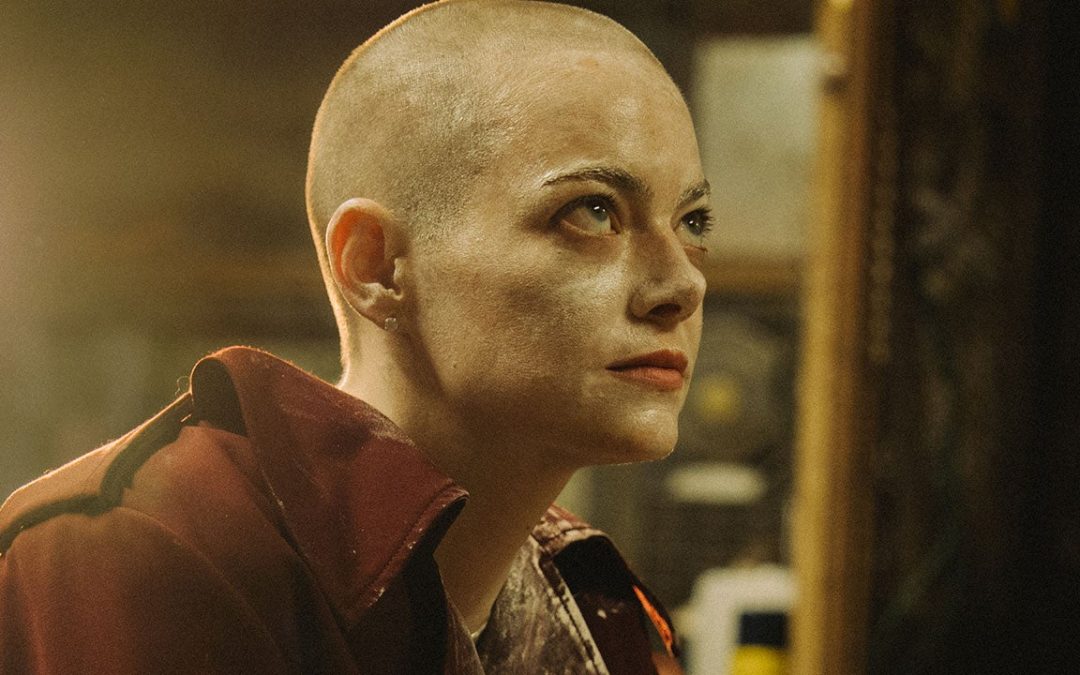
“Bugonia” is the story of a powerful CEO who gets kidnapped by a pair of conspiracy-obsessed knuckleheads who are convinced she is an alien from outer space. Emma Stone’s Michelle is the celebrated and decorated leader of a biomedical company. She is the embodiment of a modern cultural ideal: beautiful, powerful, intelligent, feminine, adept at inspiring corporate branding-speak and mixed-martial arts. She drives a Mercedes G-Wagon.
Her captors are a pair of backwoods cousins named Teddy (Jesse Plemons) and Don (Aidan Delbis). Teddy is both lithe and disheveled, smart but lacking common sense, and about 10,000 feet into a deep dive into the online world of extreme conspiracy theory. Don is the loyal follower, easily manipulated and tragic. They ride around town on bicycles.
Teddy and Don kidnap Michelle on her way home from the office, and quickly relocate her to their grimy basement. Here they reveal their intentions: they believe she is an alien from the Andromeda Galaxy, part of a conspiracy to wipe out humanity, and they want her to give them an audience with her leader.
As the story proceeds, “Bugonia” flirts with all the hot-button issues of our day. You have the conflict between the wealthy elites and the poor underclass, the issue of corporate nihilism and capitalism without accountability, and as we find out a little more about the connection between Teddy and his victim, even the subject of modern healthcare comes to the surface. And all of this plays out under the shadow of Internet conspiracy theories, and the lack of trust in traditional media.
But all these things are merely tools to play with as Michelle tries to find a way out of her predicament, and the core of “Bugonia” boils down to the question of whether she will be rescued, or if she might use her sharp wits to rescue herself.
It’s a solid premise, with some real tension, and driven by some excellent cinematography and performances from Stone and Plemons, “Bugonia” boasts some real strengths. It also has some obligatory weaknesses, such as some blind spots in the plot. For example, given that Michelle is successful enough to grace the cover of TIME Magazine, and that her captor has a pretty obvious motive, you’d think the manhunt would bring more to Teddy’s door than a local officer who seems more motivated by his own personal connection to the suspect than any genuine suspicion.
The big problem, as indicated previously, is the payoff.
“Bugonia” reminded of more than Shakespeare. It also reminded me of “If I Had Legs I’d Kick You,” and Jim Jarmusch’s “The Dead Don’t Die.” They’re all films that set you up for something bigger, something more meaningful, but settle for nihilism and cynicism. “Bugonia” was my first Lanthimos film, so based on reputation I was prepared for the cinematic visual craft, the bizarro premises, and the shocking, often comic violence. But I wasn’t prepared to be left with an ending that felt somewhere between a cop-out and a cute joke.
*Full disclosure: I had to Google the line to locate its origin; my personal catalogue of Shakespearean quotes is pretty small.
—
“Bugonia” is rated R for episodes of graphic violence, torture, profanity, and some sexual content.
At the risk of sounding too comfortable in my own echo chamber, it was great to read a critique of this film that I wholeheartedly agree with. I was screaming from the proverbial rooftops at the end of this one. No! Why the hard turn at the end? After the great performances of Plemons and Stone, the third act fell flat.