
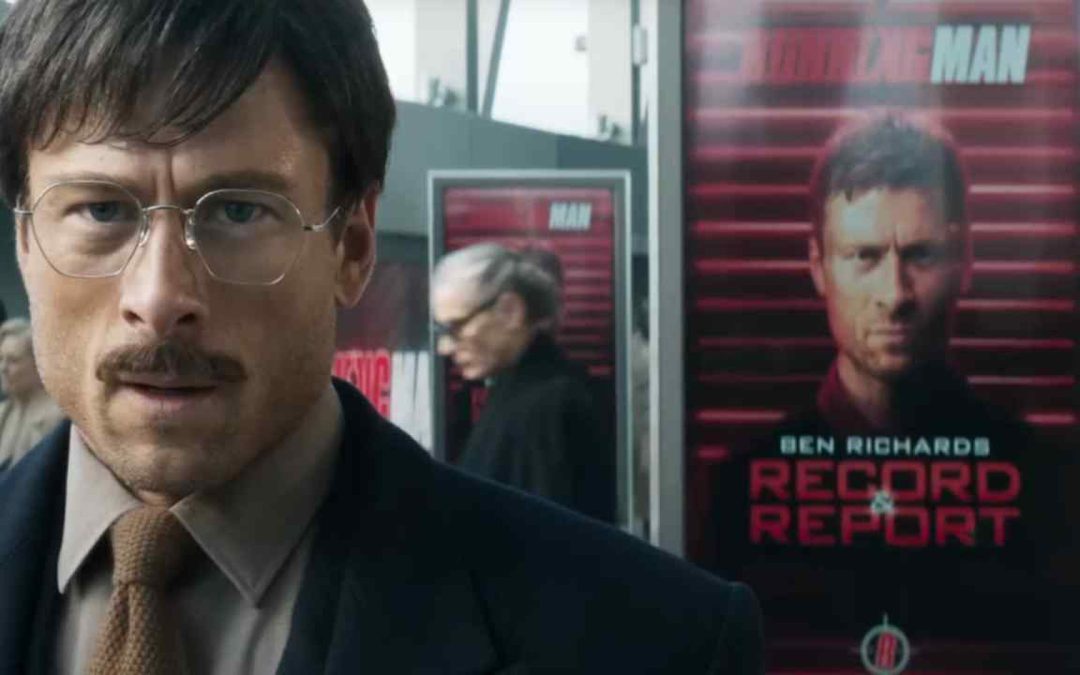
The Running Man (2 1/2 stars out of 4)
Many if not most audiences will view Edgar Wright’s “The Running Man” in comparison to the 1987 film starring Arnold Schwarzenegger, even though both films are separate adaptations of a novel by Stephen King. So without having read that novel, this review will approach the new film from the more general perspective, with apologies to the more hardcore King audience.
Set in one of the classic dystopian futures common to the best of science fiction, “Running Man” tells the story of a desperate man trying to survive a gladiatorial game show in order to save his family.
Glen Powell plays Ben Richards, a hot-tempered but dedicated family man who can’t seem to catch a break in a world where the gap between the have’s and have-not’s has widened as fast as our technology has advanced. The combination of his temper and bad luck eventually leaves him one option to provide for his wife (Jayme Lawson) and young sickly daughter: risk his life on a deadly, immensely popular game show called The Running Man.
The premise is pretty simple. Three embattled contestants are released into society with a head start and some spending money. Twelve hours later, a team of hunters is sent to track them down and execute them. If they can survive for thirty days, they win a generous cash prize.
In the ’87 film, the action was contained to a designated playing field, separate from general society. But the 2025 version feels a lot more catered to a critique of our modern culture. Aside from letting the players out into the general population, there is an additional twist: common citizens who can get footage of the contestants and rat them out stand to win cash payouts of their own.
This social media dynamic adds a sobering element to a premise that already warns of a degrading and callous culture, and mixed in with references to AI fakery and healthcare services, the Wright version feels a lot more prescient and sobering than the more comic interpretation Schwartzenegger helmed in the ’80s.
None of these elements are especially fleshed out, though, and “Running Man” suffers from a rushed and chaotic third act that feels like it’s trying to distract viewers from its unsatisfying finale. Wright’s signature style helps the production to be engaging and interesting, but compared to the previous version, it’s also a lot less fun. Fans of the first film may especially disappointed at how this version only minimally develops the personalities of the individual hunters, who got such colorful characterizations in 1987 from the likes of Jim Brown and Jesse Ventura.
Josh Brolin and Coleman Domingo are effective as the head of the network and the host of the titular program, respectively, and for his part, Powell is a sympathetic Richards, and certainly up to the physical challenge. Unfortunately he’s in the no-win situation of taking the torch from Schwartzenegger and his limitless reservoir of charisma.
Again, a lot of this might come down to a question of priorities. A quick Google search implies that the 2025 “Running Man” is more faithful to the source material, and its social commentary absolutely feels much more poignant and explicit. But the 1987 version is a lot more fun, and for audiences who are only familiar with the first movie, that comparison will stand out.
On its own, “The Running Man” is a solid but flawed commentary on 2025, and it might be interesting (if not sobering) to see how its story resonates in the years to come.
—
“The Running Man” is rated R for scattered profanity, scenes of graphic violence, and some brief male nudity.