
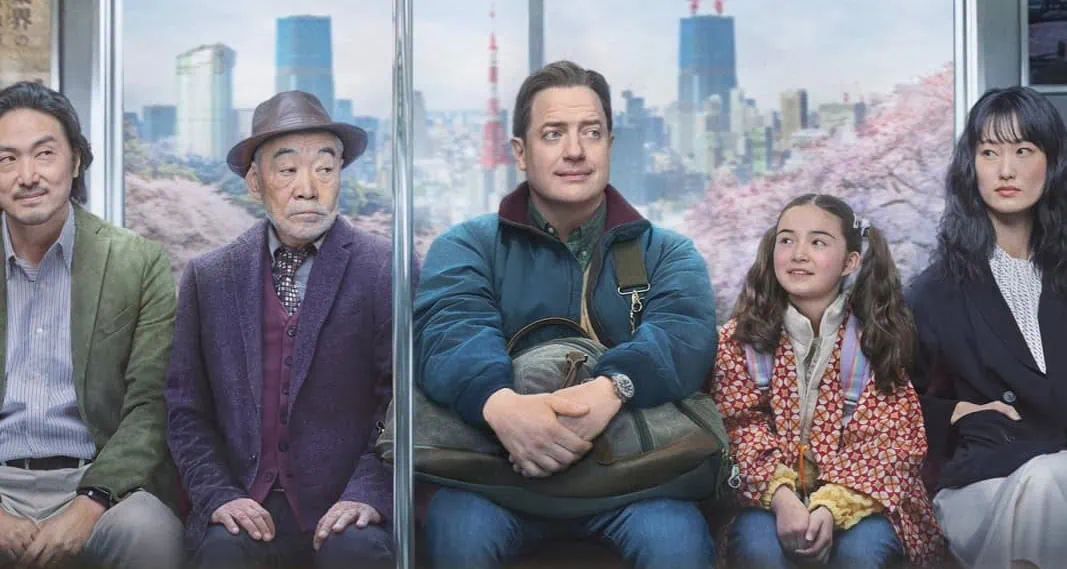
Rental Family (4 stars out of 4)
Hikari’s “Rental Family” is the kind of movie that makes me grateful to be a movie critic.
“Rental Family” tells the story of a struggling American actor who is forced to reevaluate his life when an unconventional job challenges his moral compass.
Phillip Vandarpleog (Brendan Frasier) relocated to Japan several years earlier to pursue his acting career. He’s doing enough to get by, but we learn about all we need to know as we watch him mournfully stare out the window of his apartment at his neighbors like Jimmy Stewart in “Rear Window.”
Phillip is fluent in Japanese, but he still struggles with the culture differences, and this contrast comes to a head after he accepts a last-minute job opportunity with a company called Rental Family. He arrives expecting a traditional production, but instead discovers a company that caters to clients with very peculiar needs.
In his first job, he plays a mourner at a staged funeral for a depressed man who wants to feel like his life has value. In another, Phillip pretends to be the groom at a wedding for a woman who cannot tell her parents that she is a lesbian. At first, he is hesitant to perform “real-life” roles that involve such deception, but slowly Phillip becomes more willing to participate as the job offers both financial security and a semblance of human connection.
This path eventually leads to a pair of jobs that drive the main plot. In one, he is asked to pose as a journalist in order to interview Kikuo Hasegawa (Akira Emoto) a retired actor who fears the public has forgotten his life’s work. In the second, he plays the estranged biological father of Mia (Shannon Gorman), a young girl who won’t get into a competitive prep school unless the acceptance board believes she is part of a stable two-parent household.
Initially Phillip takes solace in the help he is offering to people in need, but over time the duplicitous nature of the job leads to inevitable conflicts. Phillip starts to form a real friendship with Kikuo, which causes problems with his daughter, who fears both for her father’s health and of him finding out the truth of the arrangement. Phillip’s growing relationship with Mia is even more precarious, as her mother insists on telling her daughter that he really is the man who abandoned them years before.
As one thing leads to another, it soon becomes clear that for all our cultural differences, certain things remain universal, and to its credit, “Rental Family” is very honest and sincere in its exploration of its powerful themes.
It’s hard to imagine a better fit for Phillip than Frasier, who brings a wide-eyed, understated innocence to the role. Emoto is great fun as the eccentric former actor, and Gorman is adorable as Mia. “Rental Family” even offers us a look into the lives of the other employees, and Mari Yamamoto is especially thoughtful in her portrayal of another actor who comes to question the morality of her work.
Driven by a contemplative score by Jon Thor Birgisson and Alex Somers and some gorgeous understated visuals that bring Japan to life without showing it off, “Rental Family” is a moving and relatable film that explores the human need for connection and meaning that plagues so many in our day.
—
“Rental Family” is rated PG-13 for some scattered profanity and mild sexual content.