
Sorry, Baby (R)
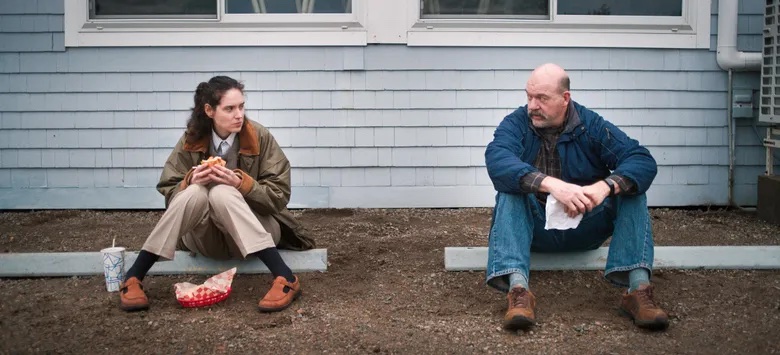
Put simply, even though the subject is anything but simple, “Sorry, Baby” is the story of a young woman trying to reconcile her experience with sexual assault. Agnes (Eva Victor) is a professor at a small liberal arts college who was assaulted as a graduate student by a PhD candidate at the same school. The storyline skips back and forth in time, putting the story together piece by piece as a reflection of the character’s own struggles to understand how to cope with and hopefully move on from her experience. We see interactions with fellow graduate students and friends, including a memorable interaction with a local sandwich maker named Pete (John Carroll Lynch). This one felt a little more personal to me, given the relatable setting and the familiar echoes of what I both enjoyed and detested about my experience with post-graduate education. But while some elements work better than others, it’s easy to come away with an appreciation for Victor’s performance (she also wrote and directed the film), and the runaway highlight of the film is the late sequence that inspires the movie’s title.
A House of Dynamite (R)
If you take it at its word, and “House of Dynamite” certainly hopes you will, Kathryn Bigelow’s new film will give you both a newfound respect for the complex process behind ensuring our nation’s safety and a sobering apprehension for those burdened with providing it. The basic idea is to take a hypothetical worst-case scenario–a nuclear missile launched at the United States, source undetermined, destination Chicago–and examine it from a variety of critical perspectives. The film groups about a dozen main POVs into three phases, shown sequentially as “House of Dynamite” loops us through the same 20-minute countdown. We watch the proceedings from the perspective of the Secretary of Defense, NORAD, the White House Situation Room, remote monitoring stations, etc. The execution is sound, and the story is interesting and compelling, even when you’ve effectively gone through the sequence a couple of times. The problem is the ending, which seems to suggest the important takeaway from the film is to appreciate the protocol rather than get a satisfying ending to the story itself.
Frankenstein (R)
Speaking of perspectives, Guillermo del Toro’s “Frankenstein” tells a re-interpreted version of the Mary Shelly classic from a pair of POVs: one from the titular doctor, and one from his creation. The film opens with a 19th century sea vessel buried in Arctic ice. Before the crew can set their ship free, they discover an injured Dr. Frankenstein (Oscar Isaac), closely pursued by a mysterious figure (Jacob Elordi) with almost superhuman strength and the uncanny ability to heal from bullet wounds. From here del Toro fills in the background with lengthy flashbacks, tracing the doctor’s journey into the inevitable, and the woman (Mia Goth) who comes between him and his creation. For its part, “Frankenstein” seems to carry all the signature elements that should make del Toro fans happy; the film is lush, cinematic, and properly macabre. It’s also pretty violent and gruesome, albeit in a strangely stylish way. It’s hard to imagine this one getting a lot of traction outside the limits of its genre, but “Frankenstein” should be a lot of fun for anyone who enjoys gothic horror or interpretations of this kind of classic literature.
The Naked Gun (PG-13)
When “The Naked Gun” was released earlier this year, my first reaction was skepticism. The notion of Liam Neeson in the title role was intriguing, but the movie just felt like the latest attempt to mine the past in order to make money in a present bereft of originality. But word of mouth suggested the movie had some merit, and it’s true that we just don’t get a lot of purely fun comedies anymore, so I decided to check it out. The verdict? It’s fine. It definitely has some laughs, and Neeson is fun in the role of Frank Drebin’s son, as is Pamela Anderson as the obligatory femme fatale (played by Priscilla Presley in the original films). You won’t remember much about the plot, but you will remember laughing more than once, and these days that’s nothing to sneeze at.
Eleanor the Great (PG-13)
I first took notice of actress June Squibb in 2024’s “Thelma,” though it turned out I had already seen her at work in 2017’s “Table 19.” “Eleanor the Great” doesn’t do much to stretch her range, but there’s nothing wrong with being the go-to option for a charismatic and sympathetic 90-year-old woman. Directed by Scarlett Johansson, “Eleanor” tells the charming story of a lonely senior who stumbles into a case of mistaken identity while trying to reconcile the loss of her longtime best friend Bessie (played in memorable flashback by Rita Zohar). When she misses a class at the local community center, Eleanor accidentally winds up meeting with a group of Holocaust survivors, where she recounts some of Bessie’s stories as her own. Naturally, one thing leads to another, and though “Eleanor’s” story feels more predictable and inevitable, the charm of its pieces go a long way.