
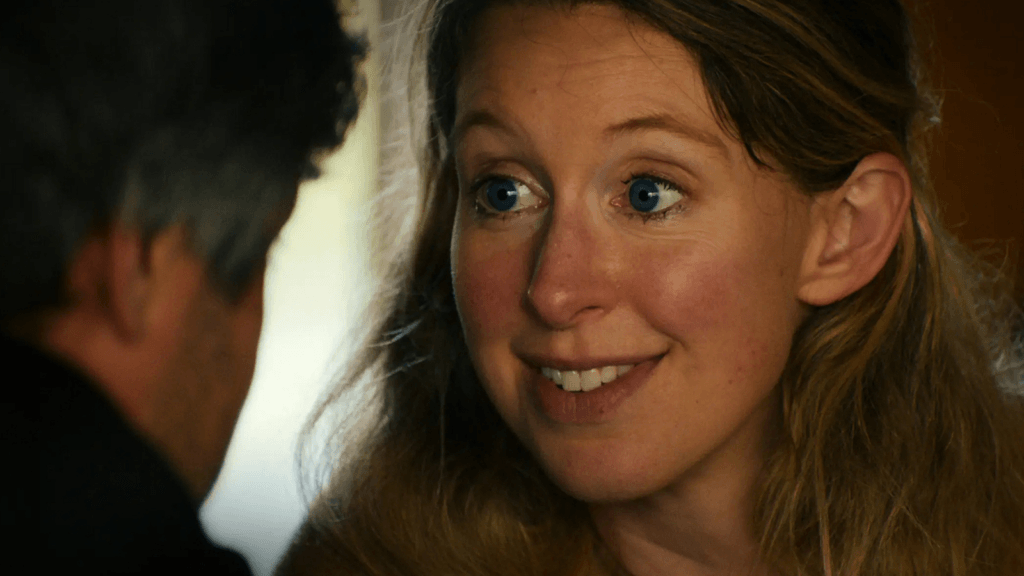
You Can See Everything (3 1/2 stars out of 4)
“You Can See Everything” is one of those documentaries that seems to raise more questions than it answers. And one of those questions is whether Nathan Fielder and Lance Oppenheim’s film is actually a documentary.
The initial premise is straightforward. Convicted ex-Theranos CEO Elizabeth Holmes has invited a team of filmmakers to cover the intimate day-to-day lives of her and her family over the last month before she is scheduled to begin her prison sentence in May of 2023.
How intimate? Well, at one point we get a lingering shot of her naked husband Billy showering after a gym workout. Though given what is to come, one must wonder if he came up with that idea himself.
The setup feels like a normal documentary concept, but what follows is odd, and often fascinating. For one thing, the film is shot so beautifully that even the casual conversations look staged, and what’s said in those conversations make it hard to believe they are real. And rather than stay behind the camera and use a normal talking-head set-up, Fielder is a constant presence in front of the character, practically to the point of feeling more like the film’s protagonist than Holmes.
The fact that Fielder comes from a comedy background also has a significant impact on the tone of the film. The director is openly skeptical of Holmes’ persistent claims of innocence, and his incredulous, deadpan delivery frequently leads to hilarious moments as he challenges her logic and struggles to reconcile her behavior. (Keep an eye out for an eye-opening sequence where Fielder shows Holmes the classic “Who’s on First?” sketch from Abbott and Costello.)
This dynamic is exacerbated by Holmes’ husband–the father of her two children–a fellow medical tech entrepreneur who could be anything from an evil puppet master taking advantage of his trusting wife to a complicit mastermind with a simple runaway ego.
Understand: this is all being drawn from the first half of the film, and the second half–the stuff that happens after Holmes goes behind bars–has to be seen for yourself. Without spoilers.
That being said, the whole package may be compelling and engaging, but it also raises a lot of questions about the ethics of documentary filmmaking, not to mention dramatizations of real-life figures. “You Can See Everything” is not worth seeing because it solves the mystery of whether or not Elizabeth Holmes knowingly defrauded her investors; it’s worth seeing because it inspires thought and debate. Not just about Theranos, but about the means Fielder and Oppenheim used to construct their film.
You might just want to avert your eyes for a bit once you see Billy hitting his gym routine.
—
“You Can See Everything” is rated R for scattered profanity and the aforementioned graphic nudity (as well as a much more discreet nursing scene).