
Highest 2 Lowest (2 ½ stars)
Spike Lee’s “Highest 2 Lowest” is an adaptation of Akira Kurosawa film “High and Low,” which was in turn based on the novel “King’s Ransom,” by Ed McBain. Now set in New York City, Lee’s film about a wealthy man in a showdown with a kidnapper is a showcase of skill, but also disjointed and overstuffed in terms of content and style.
The film opens with a beautiful montage of scenic New York cityscapes that evoke memories of Woody Allen’s 1979 film, “Manhattan,” all tied to a soaring rendition of “Oh, What a Beautiful Morning.” This introduction leads us to the posh Brooklyn penthouse of David King (Denzel Washington), a legendary music executive who is trying to buy back controlling interest in his record label.
We watch him navigate his daily business, shuttled around New York while everyone from lobby loiterers to his own son Trey (Aubrey Joseph) try to pitch him on aspiring new artists. We meet David’s wife Pam (Ilfenesh Hadera), and Paul (Jeffrey Wright), David’s driver, whose son Kyle (Elijah Wright) attends the same basketball camp with Trey. Then, just after a candid conversation with Pam about the label deal, the story takes a hard-left turn when a mysterious caller tells David he’s kidnapped his son.
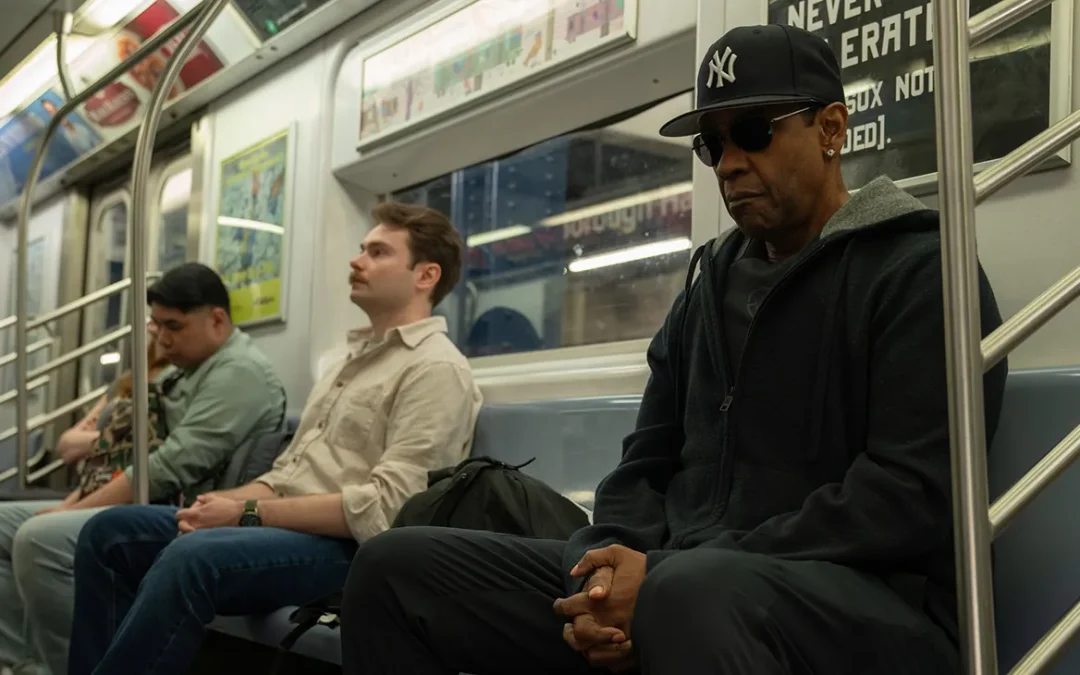
From here the film lurches into a more dramatic plot that complicates further when it becomes clear that the kidnapper grabbed Kyle by mistake. What follows is a strange if engaging mix of suspense and drama that gives the audience everything from moral dilemmas to subway chases to dark commentaries on the modern record business, underscored by the haunting social media refrain that, “attention is the greatest currency.”
The result is a curious collection of often excellent elements that never quite coheres. For its part, the dialogue is excellent, and so are the performances, which will be no surprise to anyone familiar with Washington and Wright’s past work. There are also great individual sequences, such as the aforementioned subway chase that plays out against an energetic live performance from the Eddie Palmieri Salsa Orchestra at a Puerto Rican Day festival.
The Kurosawa film and the original McBain novel were built around the same core premise: a wealthy businessman is forced into a moral dilemma when his driver’s son is kidnapped by mistake. But though Lee’s contemporary interpretation feels relevant, it also makes the film feel overstuffed. Along with the montage opening and some amusing cutaways of rabid Yankee fans, the festival footage implies that “Highest 2 Lowest” is a tribute to the energy and culture of New York City, which seems odd transposed against a kidnapping plot. Elsewhere the film points a finger of accusation against the modern society, where even criminal behavior can merit that precious attention.
By the end of the movie, it’s easy to nod in approval with much of what Lee is saying, and to admire a lot of what he does along the way. But “Highest 2 Lowest” feels more like a collection of compelling parts that don’t quite fit together, a collage more than a finished portrait.
Nowhere is this more obvious than in the way Lee’s style—and especially Howard Drossin’s gorgeous piano-driven score—just don’t feel like a match for the film’s subject matter. The lurch into the kidnapping plot just doesn’t fit the established tone and style of the film, and that dissonance continues throughout its runtime.
For a filmmaker like Lee, this might be entirely intentional, and it does have a way of keeping you attentive rather than tuning out. But to paraphrase “Highest 2 Lowest’s” critical messaging, not all attention is good attention.
“Highest 2 Lowest” is rated R for generous profanity, as well as some scattered violence and mild sexual content.