
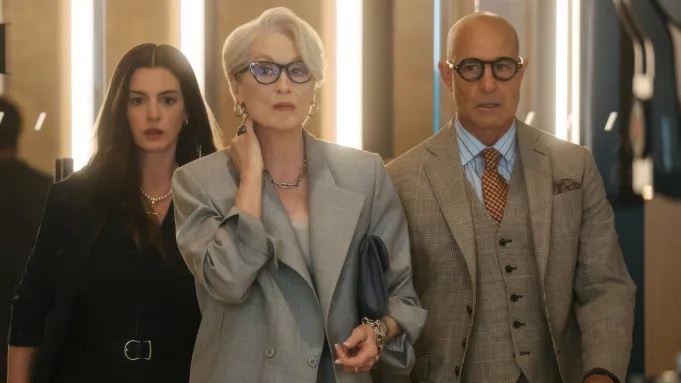
The Devil Wears Prada 2 (2 1/2 stars out of 4)
As a showcase for the creative world of modern fashion, “The Devil Wears Prada 2” works just fine. As a commentary on the impact of modern technology on traditional field like journalism, it’s OK. As an attempt to humanize its elitist characters, it struggles.
It’s been 20 years now since the release of “The Devil Wears Prada,” and David Frankel’s “Prada 2” sticks with that same timeframe. Two decades after her life-changing time at the elite fashion magazine Runway, Andy Sachs (Anne Hathaway) has built a distinguished career as a journalist, traveling the world and covering more substantial topics than the latest trends and styles.
But just as she’s about to receive a distinguished award for her work, Andy’s entire publication is erased from existence. Luckily (for her), her old boss at Runway is running into some trouble as well. A sweatshop scandal sets a sequence of events in motion, and within a few short scenes, Andy is back at Runway working as its features editor under the notorious editor-in-chief Miranda Priestly (Meryl Streep).
Neither side is happy with the arrangement, and Miranda barely seems to remember their past time together. But Andy’s situation is more desperate, so she swallows her pride and sets about proving herself yet again to the titular devil in the film’s title. The plot engine that drives this dynamic is the threat of a new owner (B.J. Novak), who represents the threat of technology and 21st century attitudes toward established institutions and values.
The demise of traditional journalism, the transition from print to online, and the advent of modern technologies like artificial intelligence are themes that almost justify the return to the world of Miranda and Andy, which I can’t imagine anyone ever saw as a potential franchise the first time around. These themes are certainly relevant, even if the film never says anything conclusive to say about them.
Instead, most of “Prada 2” is built around the relationships of its characters–which include the returns of Emily Blunt and Stanley Tucci in supporting roles–and its showcasing of the fashion world. Anyone looking for fashion eye candy and flashy cameos won’t be disappointed, even if it kind of undercuts the nobility of the industry’s cause–are we really supposed to lament the loss of an institution dedicated to covering such superficial nonsense?
The character studies are more interesting, if similarly problematic. Miranda is a complicated character, which is a nice way of saying she comes off as a “real” person in private who has no problem treating lesser people around her like garbage if they don’t meet her standards. And even a comparable “good guy” like Tucci’s character is too much of a snob to fully embrace. It’s pretty obvious that I’m not the audience for this movie, but I struggle to see how anyone would want to be a part of such a world. It’s one thing to acknowledge that high fashion prioritizes art over practicality, but it’s a lot harder to justify the elitist attitudes that go with it.
At the center of all this is Andy, who is mostly relatable and serviceable as a protagonist to cheer for. She also gets a pretty forced love interest sub-plot with a local contractor (Patrick Brammall), and her strained relationship with former co-worker Emily (Blunt) is a helpful thread.
Altogether, “Prada 2” has enough going for it to justify its existence as more than a nostalgic cash grab, but it’s a close call. Fans of the first film will probably enjoy it, but like one of Miranda Priestly’s former employees, “The Devil Wears Prada 2” feels destined to be forgotten, whether it deserves it or not.
—
“The Devil Wears Prada 2” is rated PG-13 for scattered profanity and adult content.