
The Social Reckoning (3 stars out of 4)
“The Social Reckoning” is a lower-case “g” good movie undercut by two issues: first, it is effectively a sequel to a better film (2010’s “The Social Network”). Second, it suffers from its own ideological biases.
Written and directed by Aaron Sorkin, “The Social Reckoning” tells the story of how the social media Goliath Facebook and its founder Mark Zuckerberg were investigated and called to account for the effects of its product. The story is mainly told from the perspective of Frances Haugen (Mikey Madison), a Facebook employee-turned-whistle blower who becomes an inside source for a series of Wall Street Journal investigative pieces around the time of the COVID outbreak in 2019-2020.
When we meet Frances, she’s working on Facebook’s Civic Integrity Team, a barely-tolerated effort to provide public accountability and internal moderation for the company. When she comes across footage of an old friend who seems to have made a dramatic ideological shift in her politics, Frances suspects Facebook’s content recommendations may have had something to do with the change. But her co-workers aren’t interested in her findings, so when an investigative reporter named Jeff Horwitz (Jeremy Allen White) reaches out on behalf of the Wall Street Journal, she begrudgingly cooperates.
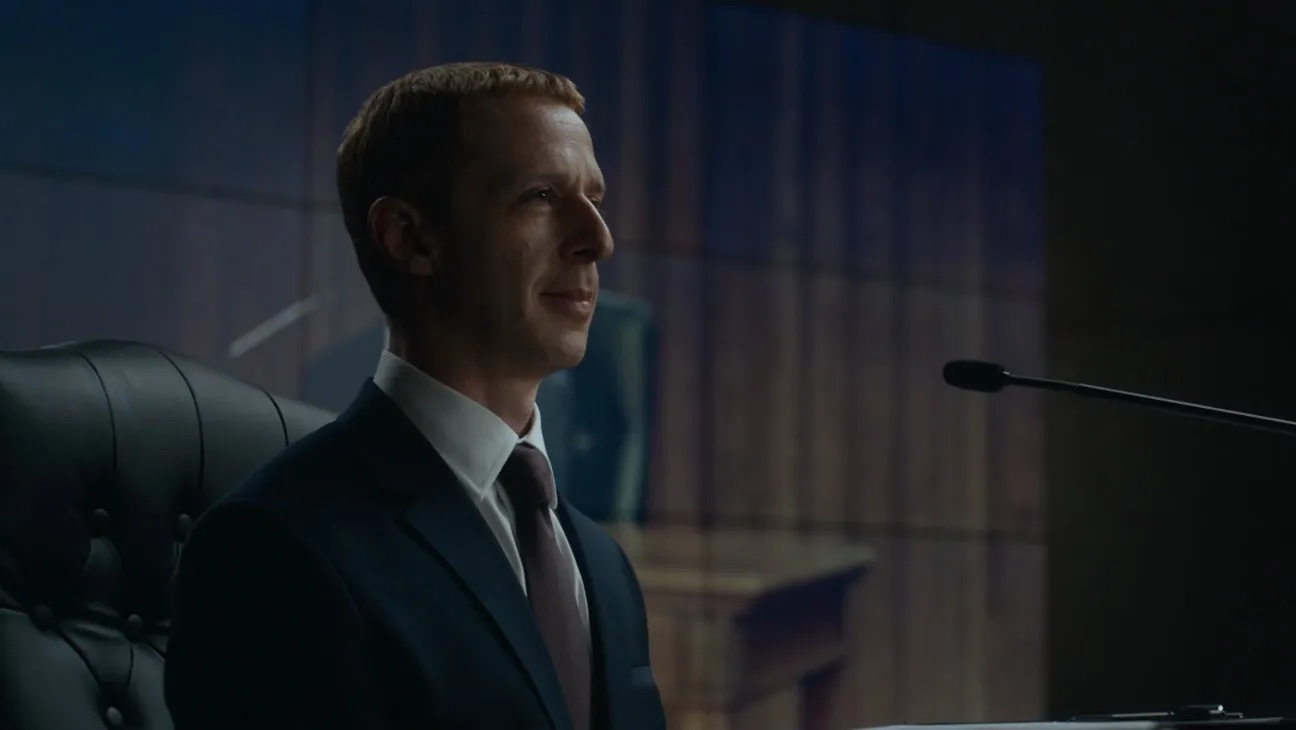
In a parallel plot that takes place two years later, Zuckerberg (Jeremy Strong) is prepping to testify before congress regarding Horwitz’s findings. As he grapples with a former associate turned critic turned consultant (Bill Burr), we are offered a glimpse of the media mogul’s rationale.
“Social Reckoning” isn’t quite a suspense thriller, but it is engaging, well-performed and relatable as it explores a present phenomenon involving a company that somehow is over 20 years old (an admittedly remarkable feat, even if to do so my feed has been reduced to a series of recommendation pages and other advertisements). Madison and White are especially solid in their roles, and the dialogue, as you might expect from Sorkin, is strong.
Strong’s performance is a good pivot to “Social Reckoning’s” more ambivalent elements. The actor’s mannerisms are a solid match for Zuckerberg, and he certainly looks the part. But that might actually work against him. Where Jesse Eisenberg’s take in “Social Network” felt familiar yet distinct, Strong’s work almost feels more like an impression, and taken in comparison with David Fincher’s earlier film, “Social Reckoning,” while still good, lacks the drama and impact of its predecessor.
Also, for anyone paying attention, the primary concern–that Facebook’s algorithm is helping to radicalize its users–only seems to move in one ideological direction. Based on its examples and illustrations–including its opening prologue and some rather heavy-handed intercuts with the January 6th riot–Sorkin’s idea of radicalization only seems to take place on the right-wing end of the political spectrum.
Altogether then, “Social Network” feels like a lot of sequels that come more than a decade after their predecessors: a flawed echo with enough merits to give it some consideration, but not enough to stick with you, or feel like the whole is greater than the sum of its parts. Not unlike Facebook itself.
—
“The Social Reckoning” is rated R for sporadic profanity.